

Wisdom Tooth Surgery
Clear information, careful assessment and a treatment plan designed around your comfort and long-term oral health.
What is wisdom tooth surgery?
Wisdom tooth surgery removes a last molar that needs a surgical approach. A gum opening, limited bone removal or dividing the tooth may be required. An impacted tooth does not automatically need surgery.
When is it considered?
- Repeated inflammation or other disease affects the wisdom tooth.
- Decay or damage affects the wisdom tooth or neighbouring tooth.
- Examination and imaging identify a problem for which surgery offers a reasonable benefit.
What is the aim?
Treat a problem wisdom tooth while considering nearby structures. The choice follows an individual assessment.
Wisdom tooth surgery: step by step
Realistic cutaway illustrations show an impacted lower wisdom tooth, removal in stages and early healing.
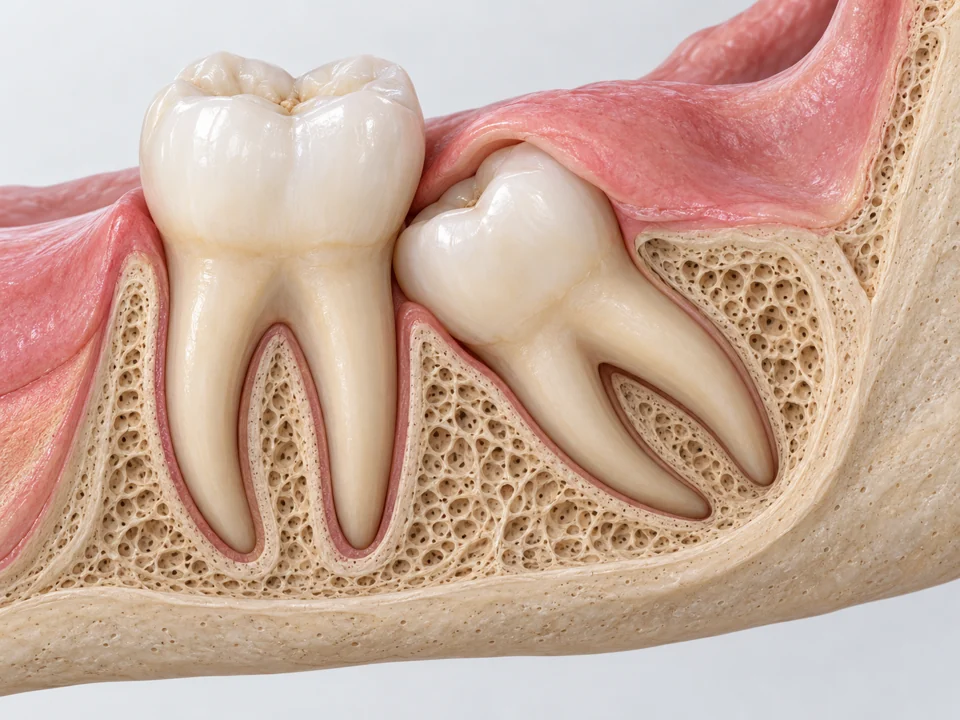
01 · Assess the impacted wisdom tooth
Examination and suitable imaging show tooth position, the adjacent molar and the relationship to nearby structures. Not every impacted tooth needs removal.
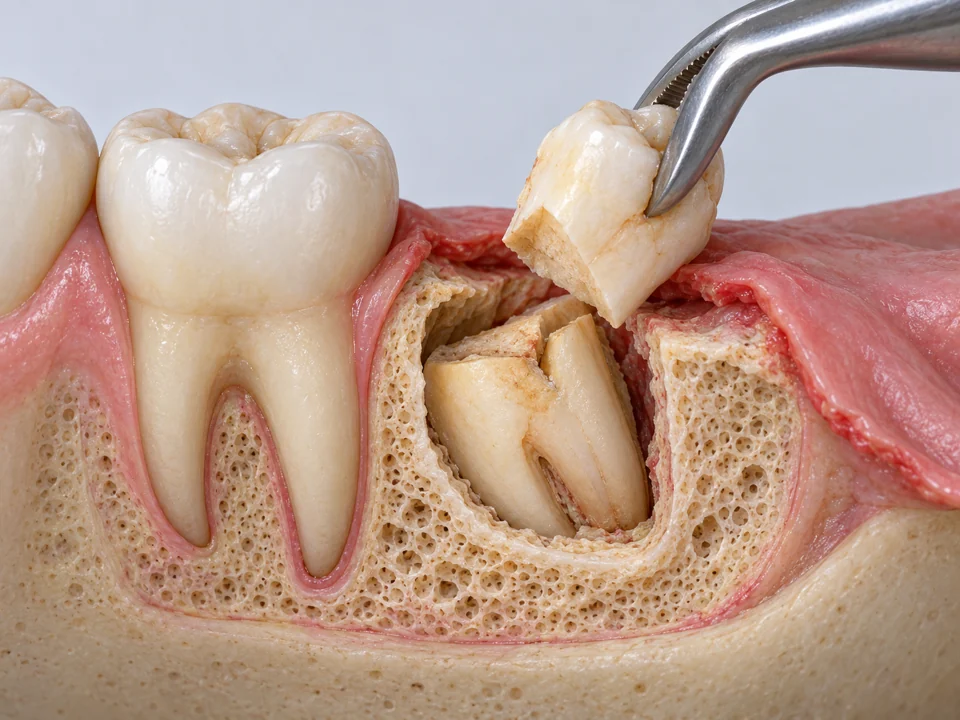
02 · Remove in sections when needed
After anaesthesia, access, limited bone removal and tooth sectioning are used only when needed. In complete removal, all planned tooth sections and roots are removed.
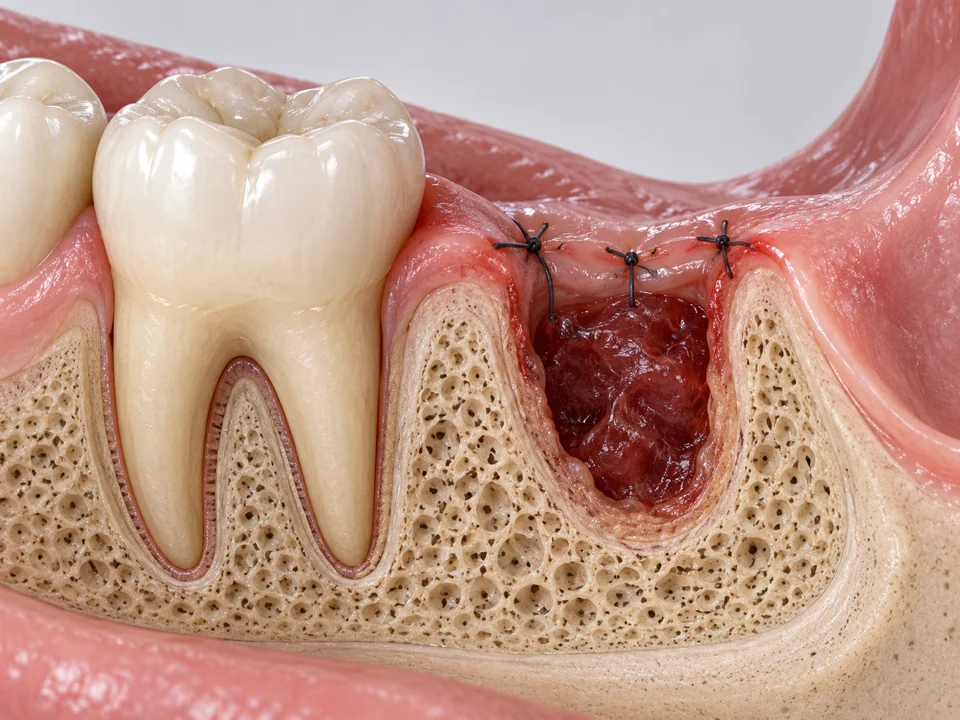
03 · Protect the clot and healing wound
A clot protects the socket. The gum may be closed with stitches. Follow the aftercare plan and attend review as advised.
Educational 3D illustrations, not patient photographs. Anatomy and nerve position vary and must be assessed on your own imaging. These show complete removal; coronectomy intentionally leaves selected roots and needs a separate plan.
An impacted wisdom tooth on X-ray
This example shows a lower wisdom tooth tilted toward the adjacent molar. We assess your own tooth with appropriate imaging before recommending treatment.
Radiograph: Nizil Shah · CC BY-SA 4.0. Resized and converted to WebP.
Treatment questions worth discussing
Does every impacted wisdom tooth need removal?
No. An impacted tooth without disease may be monitored. We weigh symptoms, examination, imaging and future review rather than recommending surgery from position alone.
Why might a CBCT scan be discussed?
A three-dimensional scan may help selected cases when conventional imaging suggests a close nerve relationship and more detail could affect treatment. It is not needed for every wisdom tooth.
What is coronectomy?
For selected lower wisdom teeth close to a nerve, a surgeon may consider removing the crown while leaving suitable roots. It has its own risks and follow-up needs; some retained roots later require treatment.
Is this different from ordinary Tooth Extraction?
Both remove a tooth when indicated. A difficult wisdom tooth may require surgical access and a more detailed discussion of nearby nerves, the adjacent molar and recovery.
Before your treatment
- Bring relevant X-rays and your medical and medicine history.
- Ask about the tooth’s relationship to nearby nerves or the sinus and whether further imaging would change the plan.
- Plan rest and transport if advised. Sedation or general anaesthesia, if arranged, requires specific instructions and an escort.
Aftercare & healing reviews
At home
- Protect the clot: avoid rinsing, spitting or disturbing the wound during the first 24 hours.
- Eat suitable soft food, avoid smoking and clean the rest of your mouth carefully.
- From the next day, follow the gentle rinsing and wound-care instructions. Do not pull at stitches.
Reviews & concerns
- Some swelling and jaw stiffness can occur; recovery varies with the surgery.
- Keep the agreed review and report persistent altered feeling after the anaesthetic should have worn off.
- Contact us for uncontrolled bleeding, worsening pain, fever, bad taste or increasing swelling.
Difficulty breathing or swallowing, or rapidly spreading swelling, needs emergency assessment. Bleeding that will not stop or severe worsening symptoms needs urgent care.
Frequently asked questions
Can a painless wisdom tooth still need assessment?
Yes. Symptoms do not reveal every problem. Examination and suitable imaging help check the tooth and its neighbour.
What does impacted mean?
The tooth cannot erupt normally because of its position or lack of space. Impaction alone does not prove that removal is needed.
Will I be asleep during surgery?
Many cases can be managed with local anaesthetic. Other anaesthetic arrangements depend on the case and need separate planning.
Will the tooth be removed in pieces?
Sometimes dividing it allows controlled removal. The planned approach depends on its position, roots and access.
Can wisdom tooth surgery cause numbness?
Lower wisdom teeth can lie close to sensory nerves. We explain your individual risk of lip, chin or tongue altered feeling before treatment.
Can coronectomy avoid all nerve risk?
No. It may reduce risk in selected teeth but is not suitable for every case. Retained roots need follow-up and can develop problems.
How long will recovery take?
It varies. Allow time for swelling, soreness and jaw stiffness to settle, and follow the activity advice made for your procedure.
Should every wisdom tooth gap receive an implant?
No. Wisdom teeth are usually not replaced. We assess the rest of your bite rather than assuming a replacement is needed.
What if pain becomes worse several days later?
Arrange a review. Dry socket, infection or another problem may need care; taking leftover antibiotics is not an assessment.
How much does wisdom tooth surgery cost in Mymensingh?
The tooth’s position, complexity, imaging and anaesthetic plan affect the estimate. We explain the planned treatment and included follow-up after examination.
Patient information sources
- NHS: wisdom tooth removal
- Cambridge University Hospitals: impacted wisdom teeth
- BAOMS: coronectomy
- Newcastle Hospitals: surgical removal of teeth
General treatment information. Your care plan follows an examination.
Ready to discuss your treatment?
Visit DentCare Dental Clinic in Charpara Mor, Mymensingh. We will assess your condition, explain the suitable options and help you choose the next step with confidence.